Is It Cheaper to Buy a Tiny Home or Build One? (The Answer Might Surprise You)
You've done the research. You've watched the videos. You've scrolled through dozens of listings. Now comes the real question: should you buy a tiny home — or have one built for you?
It's one of the most common questions we get asked here at Cocoon Homes, and honestly, the answer isn't as simple as most people expect. The sticker price on a used tiny home might look appealing at first glance, but once you factor in everything that actually goes into owning one, the math changes fast. Let's break it down — no fluff, just the real numbers and the things nobody talks about.
 The Quick Snapshot
On the surface, it looks like a straightforward comparison. According to HomeAdvisor and HomeGuide, the cost to build or buy a tiny home in 2025 typically falls somewhere in the $30,000–$70,000 range, with the average sitting around $45,000–$67,000 depending on the source. Tiny homes generally run about $150–$450 per square foot — which, for context, is actually higher on a per-square-foot basis than a traditional home, because you're still fitting a full kitchen, bathroom, and all the core systems into a much smaller footprint.
At Cocoon Homes, our custom builds start around $55,000 and go up to about $104,000, depending on size, finishes, and features. That puts us right in line with the market — but what you're getting for that price is very different from what you'd get buying used. We'll get into that.
The Case for Buying Used: What People Think They're Getting
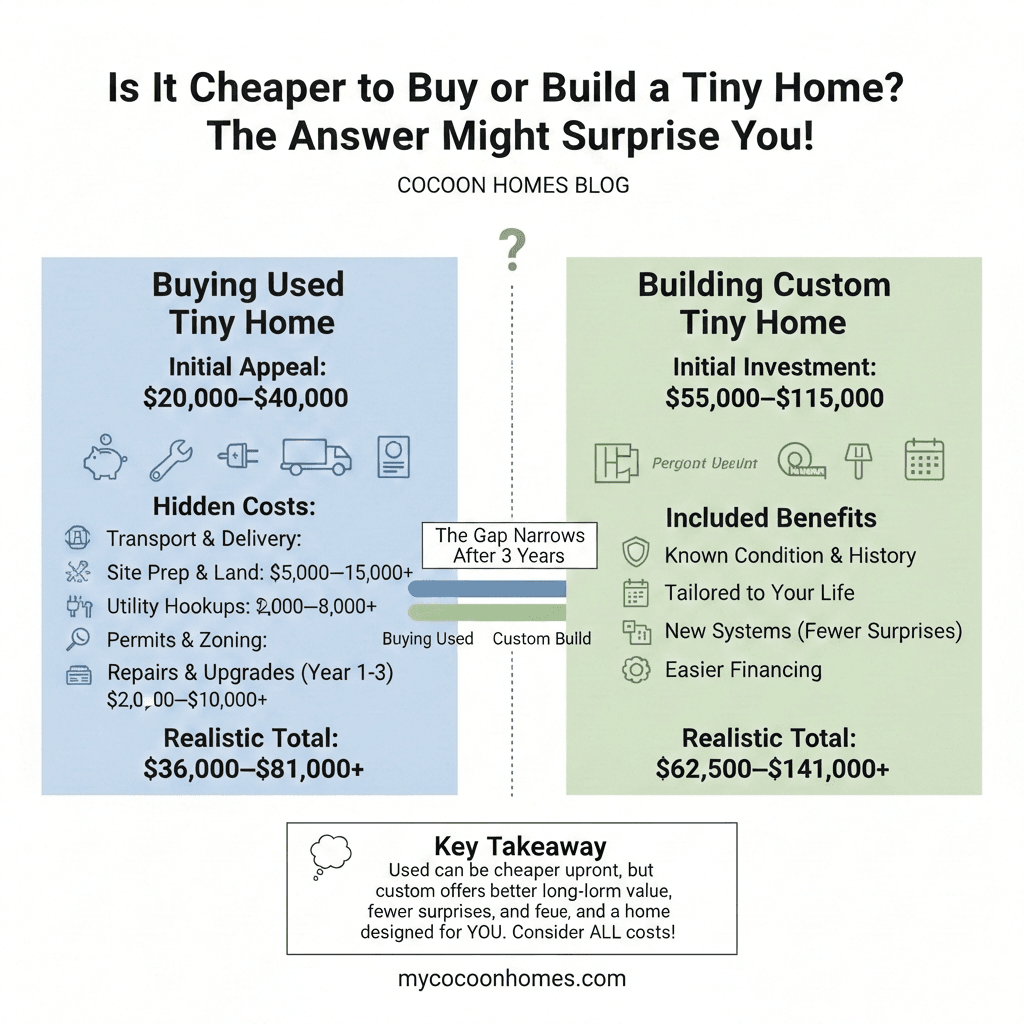
The pitch for buying a used tiny home is simple: pay less, skip the wait, move in faster. And on paper, that makes sense. Used tiny homes can show up for $20,000–$40,000 in some markets, which is a number that gets a lot of attention.
Here's the thing — that number is just the starting point.
What the listing price doesn't include:
When you buy a used tiny home, you're buying someone else's project. That means you're inheriting their design choices, their material selections, and — here's the part that makes a lot of people nervous — their maintenance history. You don't always know how the previous owner used the space, how well the plumbing and electrical systems were maintained, or whether the insulation is holding up the way it should.
Beyond the unknown condition of the home itself, there are a handful of costs that tend to quietly pile up:
Transport and delivery. Unless you're buying locally, getting a tiny home moved to your property isn't free. Depending on distance, weight, and the type of transport needed, this can run anywhere from a few hundred dollars to several thousand.
Site preparation and land development. This is the big one that catches people off guard. If your land needs grading, clearing, or a new access road, you're looking at real money — and this cost applies whether you buy or build. But it's a cost that used-home buyers often don't budget for because they're so focused on the purchase price.
Utility hookups. Connecting water, sewer, and electricity to a new site isn't a one-phone-call situation. Depending on your location, this can be a significant expense on top of everything else.
Permits and zoning compliance. Even if the home already exists, placing it on your property may require permits. And if the previous build didn't meet current local codes, you might be looking at modifications before you can legally live there.
Repairs and upgrades. Used homes come with used systems. If the water heater is aging out, or the roof needs attention, or the electrical panel needs upgrading — that's on you now.
When you start stacking all of these costs on top of a $25,000 used tiny home, the "deal" starts looking a lot less like a deal.
The Case for Building: Why Custom Actually Makes More Sense Than You'd Think
Building a tiny home — especially with a professional builder — sounds like it should be the more expensive route. And in terms of the initial quote, it sometimes is. But here's what the build side gets you that buying used simply can't match:
You know exactly what you're getting. Every material, every system, every inch of the build is something you chose or approved. There's no guessing about the history of the plumbing or whether the previous owner cut corners on insulation. It's built to your spec, from scratch.
You get to design around your actual life. A tiny home is small enough that every single square foot matters. When you build, you get to decide where the kitchen is, how the sleeping area works, and where the storage goes. When you buy used, you're adapting your life to someone else's layout. That's a real trade-off.
No surprises after move-in. With a new build, you're starting with brand-new systems. New plumbing. New electrical. New roof. You're not going to be hit with a $3,000 repair six months in because the previous owner's water heater finally gave out.
Long-term value. A custom-built tiny home — especially one done well — holds its value better than a used one that's already depreciated. Think of it like the difference between buying a used car and buying new. The used one might be cheaper today, but it's also closer to the end of its life.
Easier financing options. Here's something most people don't realize until they start calling lenders: getting a loan for a used tiny home is surprisingly difficult. Traditional mortgage lenders won't touch them because they're not considered real property, and even RV loans can be hard to secure for older units or homes without a clear title history. When you build new with a reputable builder, you have more financing options available. Many builders work with lenders who specialize in tiny homes and THOWs, and some even offer in-house financing or payment plans. Plus, a new build comes with clear documentation, a clean title, and an appraised value lenders can actually work with — none of which is guaranteed with a used purchase.
The THOW Advantage: A Smarter Way to Keep Costs Down
One of the smartest moves in the tiny home world right now is building a Tiny Home on Wheels — or THOW. And there's a reason why builders like us lean into this option heavily.
A THOW is built on a custom trailer, which means it technically qualifies as a towable RV in many jurisdictions. What does that mean for you? It can dramatically simplify the permitting process. In a lot of areas, a THOW sidesteps the building code requirements and zoning restrictions that a foundation-based home would face — and those permits and inspections are not cheap.
That said, THOWs aren't for everyone. If you plan to stay put long-term and want your home to appreciate in value, a foundation build is probably the better long-term play. But if flexibility matters to you, or if you're trying to keep the upfront cost as low as possible while still getting a quality, custom-built home — a THOW is hard to beat.
At Cocoon Homes, our THOW trailers are designed a little differently than what you'll find elsewhere. The tongue is fully removable, so once your home is delivered and set, it can be skirted to look like a permanent structure. The wheels sit completely below the frame, so there are no interior wheel wells eating up your living space. It's the best of both worlds — the cost savings of a THOW with the look and feel of a home that's here to stay.
So, Which Is Actually Cheaper? Let's Do the Math
Here's where it gets real. Let's look at a simplified, side-by-side comparison using realistic numbers:
| Cost Category | Buying Used | Custom Build (New) |
|---|---|---|
| Home Purchase/Build Price | $25,000 – $40,000 | $55,000 – $115,000 |
| Transport & Delivery | $1,500 – $5,000 | $1,500 – $5,000 |
| Site Prep & Development | $5,000 – $15,000+ | $5,000 – $15,000+ |
| Utility Hookups | $2,000 – $8,000 | $2,000 – $8,000 |
| Permits & Inspections | $500 – $3,000+ | $500 – $3,000+ (or less with THOW) |
| Repairs/Upgrades (Years 1-3) | $2,000 – $10,000+ | Minimal |
| Realistic Total | $36,000 – $81,000+ | $62,500 – $141,000+ |
On the surface, buying used still looks cheaper in most scenarios. But here's what that table doesn't capture: the repairs and surprises on a used home don't stop after year three. They keep coming. And the custom build starts from a place of quality and control that a used home simply can't match.
The bottom line? If you can find a screaming deal on a used tiny home in great condition — and you're confident in its history — it can be the cheaper option. But for most people, once you factor in everything realistically, the gap between buying used and building new narrows a lot. And when you factor in the value of knowing exactly what you have, designing a space that actually fits your life, and not dealing with someone else's surprises, building starts to look like the smarter investment.
What Actually Matters When You're Deciding
Before you commit either way, there are a few things worth thinking through:
Where are you putting it? Land costs and development needs are huge variables, and they apply no matter which route you take. If you already own land and it's ready to go, that changes the equation significantly.
How long are you planning to stay? If this is a long-term home, building new makes a lot of sense. If you're more likely to move in a few years, a used THOW might be a more practical choice.
How hands-on do you want to be? Building with a good builder means you get input on the design without having to swing a hammer yourself. Buying used means you might end up doing a lot of the repair and renovation work on your own.
What matters most to you in the space? If layout, design, and customization are important to you — and in a tiny home, they really should be — building is the way to get exactly what you want.
The Cocoon Homes Perspective
We're not going to pretend we're unbiased here — we build tiny homes for a living, so we obviously think it's a great option. But we also genuinely believe in helping people make the right decision for their situation. That's why we consult with every single client before a single nail gets driven.
If buying used makes sense for your budget and your situation, we'll tell you that. But in our experience, most people who go the used route end up spending more than they expected — and wishing they'd just built the home they actually wanted from the start.
If you're curious about what a custom build could look like for your budget, we'd love to talk. No pressure, no sales pitch — just a real conversation about what's possible.
Explore our floor plans HERE
Disclaimer: Cost estimates in this article are based on national averages from industry sources, including HomeAdvisor, HomeGuide, and Rocket Mortgage as of 2025. Actual costs will vary significantly based on location, size, materials, land conditions, and local zoning requirements. Always consult with a local builder and your municipality before making decisions.